MLA Handbook

Resources
MLA citation is used primarily in literature, art and the humanities.
If you need more information than what is given in this guide, try the following sources:

More from the Online Writing Lab (OWL)
From Purdue University:
Using Research
https://owl.english.purdue.edu/owl/section/2/9/
For the OWL handout on MLA style:
https://owl.english.purdue.edu/owl/resource/747/01/
Notice
This is only intended to be a basic guide to get you started. Your professor may have specific or additional requirements not listed in this guide. If you need additional help, schedule an appointment at the Writing Center!
Citations Formats - 8th Edition Rules
Because there are now so many types of sources and it would be nearly impossible to create a citation for every source, MLA 8th edition now has one standard citation format that can be applied to every source. In this format, "title" refers to a book chapter, article, website or other item that exists within another source while "container" is the title of the book, journal, website, or other full resource.
If a work has a DOI, MLA requires that to be added at the end of the citation. If an online article does not have an DOI, you may use the URL.
Standard Format:
Author Last Name, First Name. "Title." Title of Container, Other Contributors (translated by or edited by First Name Last Name), Version, Number, Publisher info, Date of publication, Location.
Book Format:
Author Last Name, First Name. Book Title. Other Contributors (Translated by or Edited by First Name Last Name), Edition, Vol/Number, Publisher info, Year, Location.
Example:
Buckman, Alyson R. Intersectional Humanism and Star Trek: Discovery: Warping into a Connected Future. Lexington Books, 2024.
Online book:
Daliot-Bul, Michal, and Nissim Otmazgin. The Anime Boom in the United States: 1972-1989. Harvard University Asia Center, 2017, https://doi.org/10.2307/j.ctvrs9046.
Editor (no author/chapter author):
Karjalainen, Toni-Matti, editor. Sounds of Origin in Heavy Metal Music. Cambridge University Press, 2018.
Two authors - first author is listed last name, first name and the second author is first name last name:
Glasby, Matt, and Barney Bodoano. The Book of Horror: The Anatomy of Fear in Film. Quarto Publishing Group, 2020.
Three or more authors - list first author followed by comma and et al. (", et al."):
Leigh, Jennifer, et al. Women in Supramolecular Chemistry: Collectively Crafting the Rhythms of our Work and Lives in STEM. Policy Press, 2022, doi:10.47674/9781447362395.
Here are other book citation formats you may come across. Please note that this is not a complete list of every possibility, but it should cover the most common formats.
Book Format:
Author Last Name, First Name. Book Title. Other Contributors (Translated by or Edited by First Name Last Name), Edition, Vol/Number, Publisher info, Year, Location.
Chapter from edited book:
Author Last Name, First Name. "Chapter Title." Book Title, Other Contributors (translated by or edited by First Name Last Name), Publisher info, Year, Page numbers.
Bergen, Teresa. "From Bigfoot Stole My Husband." The Folklore Muse: Poetry, Fiction, and Other Reflections by Folklorists, edited by Frank de Caro, University Press of Colorado, 2008, pp. 84-90.
One volume in multivolume set:
Author Last Name, First Name. Title of Set, Other Contributors (translated by or edited by First Name Last Name), Volume number, Publisher info, Year, Location (if available).
Example:
Encyclopedia of Human Emotions. Edited by Levinson, D., Ponzetti, J. J., & Jorgensen, P. E., vol. 2, Macmillan Reference USA, 1999.
Edition other than first edition:
Author Last Name, First Name. Book Title. Other Contributors (Translated by or Edited by First Name Last Name), Edition, Publisher info, Year, Location.
Example:
Clements, Jonathan. Anime: A History. 2nd ed., Bloomsbury, 2023.
Dissertation or thesis:
Author Last Name, First Name. Document Title. Year, Degree granting institution, PhD dissertation/Master's thesis, Database name or URL if available.
Example:
Soares, Rodrigo M. Dung Beetle Communities and Impact on Dung Degradation and Horn Fly Population Under Different Management Practices. 2024, Oklahoma State University, Master's thesis. ProQuest Dissertations & Thesis.
Because there are now so many types of sources and it would be nearly impossible to create a citation for every source, MLA 8th edition now has one standard citation format that can be applied to every source. In this format, "title" refers to a book chapter, article, website or other item that exists within another source while "container" is the title of the book, journal, website, or other full resource.
If a work has a DOI, MLA requires that to be added at the end of the citation. If an online article does not have an DOI, you may use the URL.
Journal Format:
Author Last Name(s), First Name. "Article Title." Journal Name, volume, issue/number, Year, inclusive pages. DOI (preferred) or URL of online article
Examples:
Eldem, Umut, and Beşir Ö. Nayır. "Ethics and Technology: An Analysis of Rick and Morty." Open Philosophy, vol. 5, no. 1, 2022, pp. 1-16. https://doi.org/10.1515/opphil-2020-0155
Online article:
Anisfield, Nancy. "Godzilla/Gojiro: Evolution of the Nuclear Metaphor." Journal of Popular Culture, vol. 29, no. 3, 1995, pp. 53-63. https://doi.org/10.1111/j.0022-3840.1995.00053.x.
Article with no issue number, no page numbers:
Spencer, R. Dinosaurs: A New, Hip Way to Breathe. eLife, vol. 10, 2021, https://doi.org/10.7554/eLife.70947.
Three or more authors - list first author followed by comma and et al. (", et al."):
Abrams, Elissa M., et al. "Global Burden of 369 Diseases and Injuries in 204 Countries and Territories, 1990–2019: A Systematic Analysis for the Global Burden of Disease Study 2019." Lancet, vol. 396, no. 10258, 2020, pp. 1204-1222. https://doi.org/10.1016/S0140-6736(20)30925-9.
Magazine articles:
Author Last Name(s), First Name. "Article Title." Magazine Title, vol (if available), issue (if available), Day Month Year (if available), inclusive pages. URL of online article.
Example:
Hiatt, Brian. "The Brain Behind Barbie." Rolling Stone, no. 1377/1378, July 2023, 92-95.
Newspaper articles:
Author Last Name(s), First Name. "Article Title." Newspaper Title, Day Month Year (if available), column location. URL of online article.
Example:
Holden, Stephen. "The Lizzie Borden Story with a Rock Attitude: Here." New York Times, 15 Sept. 1994, p. C15.
Book reviews:
Review Author Last Name(s), First Name. "Title of Review." Review of Title, by Author Name. Journal Name, volume, issue/number, Year, inclusive pages. DOI (preferred) or URL of online article.
Example:
Stables, Kate. "Ghibliotheque." Review of Ghibliotheque, by M. Leader & J. Cunningham. Sight and Sound, vol. 31, no. 8, 2008, p. 102. https://ezproxy.library.astate.edu/login?url=https://www.proquest.com/magazines/ghibliotheque/docview/2580083268/se-2.
Because there are now so many types of sources and it would be nearly impossible to create a citation for every source, MLA 8th edition now has one standard citation format that can be applied to every source. In this format, "title" refers to a book chapter, article, website or other item that exists within another source while "container" is the title of the book, journal, website, or other full resource.
If a work has a DOI, MLA requires that to be added at the end of the citation. If an online article does not have an DOI, you may use the URL.
Website Format:
Author Last Name, First Name (if available). "Webpage Title." Title of Website, Date of creation (if available), DOI (preferred)/URL. Date of access (if publication date isn't available or if page may change later).
Examples:
Mello-Klein, Cody. "Twenty-Five Years Later, SpongeBob is Still Living His Best Life Under the Sea." Northeastern Global News, 22 Oct. 2025, https://news.northeastern.edu/2025/10/22/spongebob-25th-anniversary-tv-culture/.
No creation date - include access date:
Mavity, Rachel S. "Be Real: What I've Learned So Far from My Little Pony." Beebe Healthcare, https://www.beebehealthcare.org/health-hub/womens-health-blog/be-real-what-ive-learned-so-far-my-little-pony. Accessed 17 Nov. 2025.
No author:
"Headbanging Can Cause Brain Injury, Say German Doctors." BBC News, 4 July 2014, https://www.bbc.com/news/health-28144928.
In addition to creating a works cited or reference list at the end of your paper, you must also give credit within the text of your paper. This is done through an in-text citation in parentheses ( ) at the end of the sentence. This is also called a parenthetical citation.
Direct Quotes
When quoting directly from an author or source, you need the author's last name and page number. If you use the author's name in the sentence, then you don't have to repeat it in the parenthetical citation.
Examples:
According to Karjalainen, "Finnish Metal is surprisingly consistent" (2).
In Sounds of Origin in Heavy Metal Music, he stated, "Finnish Metal is surprisingly consistent" (Karjalainen 2).
Paraphrasing/Summarizing
When paraphrasing or sharing an author's ideas in your own your own words, you also need the author's last name and page number. If you use the author's name in the sentence, then you don't have to repeat it in the parenthetical citation.
Examples:
According to Glasby and Bodoano, even though horror is subjective, there are patterns to what frightens us (8).
Even though horror is subjective, there are patterns to what frightens us (Glasby and Bonoano 8).
Multiple authors:
If your citation has two authors, list them both in the in-text citation. However if there are three or more authors, use the first author's last name followed by "et al.".
Examples:
The animated TV-show Rick and Morty "depicts several important and relevant themes about the impact of technology in contemporary societies" (Eldem and Nayir 1).
According to Abrams et al., the Global Burden of Diseases, Injuries, and Risk Factors Study (GBD) provides the most up-to-date assessment of the descriptive epidemiology of diseases and injuries (2225).
No authors:
If your resource does not have an author or editor, use a shortened version of the title. Shorter formats, such as articles, should be in quotation marks " " and longer works like books, movies, and entire websites should be italicized. If there is a page number, include that after the shortened title.
Example:
While headbanging has been linked to health complications, it is generally considered harmless ("Headbanging").
Formatting Your Paper
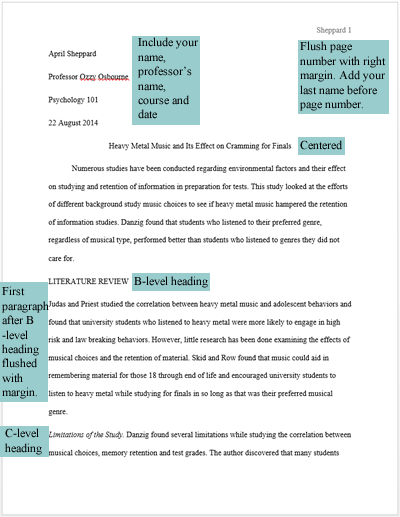 |
Formatting
Page Number and Name
Top Information
Headings
|
 |
Formatting
Page Number and Name
Indentation
|
A hanging indent is when the first line of text is flushed with the margin while the other lines within the text are indented in.
Here's how to create hanging indents in Microsoft Word:
|
Step 1: Select the text you want to be hanging indents |
 |
Step 2:
From the "Page Layout" tab, click on the Paragraph Settings icon.

|
Step 3: In the middle of this box will be your indentation options. Under "Special" select "Hanging" then hit the "OK" button. |
 |
|
Success! You have have hanging indents! |
 |


